Art and the River Deben
1 - 16 October 2022
The first of two newly commissioned cross-disciplinary exhibitions exploring artists’ connections to rivers which launches our Art and Environment season. A percentage of sales of works from the exhibitions will go towards supporting sustainable river projects in East Anglia.
Art and The River Deben celebrates Suffolk’s River Deben which flows for nearly 25 miles from its source near Debenham to the North Sea at Felixstowe Ferry. All the artists have longstanding connections to the River Deben.
Lotte Attwood (photography); Ros Conway (enamels); Janine Hall (drawings); Simon Read (drawings); Annie Turner (clay sculpture)
About the artists
LOEWE Prize shortlisted ceramic sculptor Annie Turner (b.1958) grew up beside the Deben learning to sail, swim and fish for herring using driftnets. Her passion for, and immersion in, this intertidal landscape was born of a working connection to the river which continues to exert major influence on her ceramic forms. Works become metaphors for the process of change, holding memories as well as making direct reference to the manmade wooden structures that emerge and submerge at different points of the tide: jetties, groynes, sluices, sinkers, fish traps.
Lotte Attwood (b.1952) is similarly drawn to this manmade river architecture, visiting the Deben over many decades to capture the graphic forms shown here in a series of newly printed, black and white images. Her work is inspired by the element of change in river landscapes, and she aims to evoke the atmosphere of that in her work.
Enameller and glassmaker Ros Conway (b.1951) and visual artist Simon Read (b. 1949) created a home and two studios on the Deben in the 1970s by restoring a Dutch barge in Woodbridge. Conway’s fine enamelling is seen here in a series of intricate brooches which explore river flora and two pate de verre glass forms that are part of her Nereides series. Two map drawings by Read reflect the artist’s interest in how imagination, and visual language – the key tools of artistic life – might help us develop a more environmentally sustainable relationship to rivers.
Janine Hall’s drawings emerged from two years of lockdown walks along the Deben. Her first career as Graphic Designer in London shifted when she went back to college to study Fine Art and Painting. Drawing has always been central to her work and her evocative pencil drawings capture the interplay of light and shadow in the changing state of the intertidal zones.
Available Works
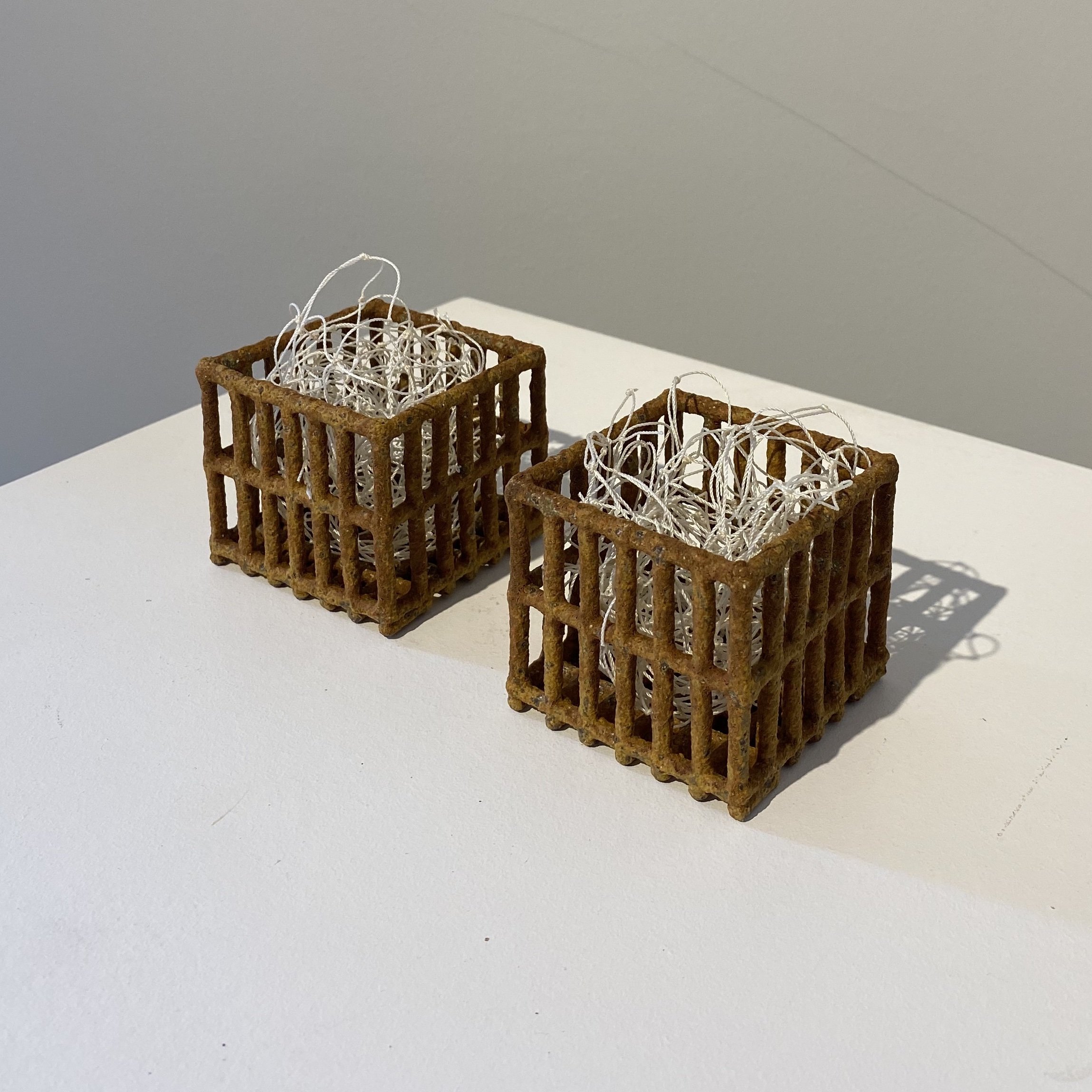
‘Herring Net’ 2022
Hand built stoneware, glazed using lithium and a variety of oxides and fired to 1220oc – 1230oc
6 x 6 x 5cm
£425 each
ANNIE TURNER b. 1958 grew up beside the River Deben, in Suffolk, learning to sail, swim and fish for herring using driftnets. Her passion for, and immersion in, this intertidal landscape was born of a working connection to the river which continues to exert major influence on her ceramic forms. Layers of coiled clay ‘ropes’ are built into intricate openwork structures which, with names such as ‘Net’ ‘Mussel Bed’ ‘Jetty’ talk of the river’s architecture not just as the ‘acres of silent mudflats and meandering creeks’ but of man’s continuous living relationship to the river through time. Turner works with the dynamic processes of kiln firing clay to develop her compelling sculptural forms, learning to control, work with and adjust the slump, shift and tilt of the clay structures, during firing.
‘Mussel Box’ 2022
Hand built stoneware, glazed using lithium and a variety of oxides and fired to 1220oc – 1230oc
2 part form
19 x 12cm
ANNIE TURNER b. 1958 grew up beside the River Deben, in Suffolk, learning to sail, swim and fish for herring using driftnets. Her passion for, and immersion in, this intertidal landscape was born of a working connection to the river which continues to exert major influence on her ceramic forms. Layers of coiled clay ‘ropes’ are built into intricate openwork structures which, with names such as ‘Net’ ‘Mussel Bed’ ‘Jetty’ talk of the river’s architecture not just as the ‘acres of silent mudflats and meandering creeks’ but of man’s continuous living relationship to the river through time. Turner works with the dynamic processes of kiln firing clay to develop her compelling sculptural forms, learning to control, work with and adjust the slump, shift and tilt of the clay structures, during firing.
Ufford Bridge, 2021
Walking the Deben Series
Graphite on paper
35 x 42 cm
JANINE HALL b. 1953 studied Graphic Design at Hornsey and the Royal College of Art. Following a thirty-year career as a Graphic Designer in London, she then returned to part time study at Wimbledon College of Art studying Fine Art Painting and Drawing completing an MA Drawing with Distinction in 2017. She divides her time between London and Suffolk. During the pandemic, based in Suffolk, the artist began a monthly walk along the River Deben, aiming to walk, and observe the river in all its states and began a series of drawings that reflect the changing mood of this tidal river.
The things that are constant, sometimes without me realising, are shadow and light often attached to fleeting moments and observations of the abstract in the world around me. Chance and balance play a big part in how the work develops.
Waldringfield, 2021
Walking the Deben Series
Graphite on paper
35.5 x 42 cm
JANINE HALL b. 1953 studied Graphic Design at Hornsey and the Royal College of Art. Following a thirty-year career as a Graphic Designer in London, she then returned to part time study at Wimbledon College of Art studying Fine Art Painting and Drawing completing an MA Drawing with Distinction in 2017. She divides her time between London and Suffolk. During the pandemic, based in Suffolk, the artist began a monthly walk along the River Deben, aiming to walk, and observe the river in all its states and began a series of drawings that reflect the changing mood of this tidal river.
The things that are constant, sometimes without me realising, are shadow and light often attached to fleeting moments and observations of the abstract in the world around me. Chance and balance play a big part in how the work develops.
Waldringfield, Incoming Tide, 2021
Walking the Deben Series
Graphite on paper
35 x 42 cm
JANINE HALL b. 1953 studied Graphic Design at Hornsey and the Royal College of Art. Following a thirty-year career as a Graphic Designer in London, she then returned to part time study at Wimbledon College of Art studying Fine Art Painting and Drawing completing an MA Drawing with Distinction in 2017. She divides her time between London and Suffolk. During the pandemic, based in Suffolk, the artist began a monthly walk along the River Deben, aiming to walk, and observe the river in all its states and began a series of drawings that reflect the changing mood of this tidal river.
The things that are constant, sometimes without me realising, are shadow and light often attached to fleeting moments and observations of the abstract in the world around me. Chance and balance play a big part in how the work develops.
Britannia silver, enamel and fine gold wire brooch
4cm diameter
ROS CONWAY b. 1951 studied at Central School of Art and Design and the Royal College of Art. London. For over thirty years she lived and worked on a converted Dutch barge, Jacoba, on the River Deben, at Woodbridge. She began working with fine enamels in 1980 to explore ways of bringing a more painterly palette onto the metal, studying with master enameller, Jane Short. Her longstanding interest in studying, and drawing, her river environment is shown in this series of brooches which developed from a series of test pieces for Goldsmiths’ Company, London’s 2004 commission for a Wafer Box.
Britannia silver, enamel and fine gold wire brooch
4cm diameter
ROS CONWAY b. 1951 studied at Central School of Art and Design and the Royal College of Art. London. For over thirty years she lived and worked on a converted Dutch barge, Jacoba, on the River Deben, at Woodbridge. She began working with fine enamels in 1980 to explore ways of bringing a more painterly palette onto the metal, studying with master enameller, Jane Short. Her longstanding interest in studying, and drawing, her river environment is shown in this series of brooches which developed from a series of test pieces for Goldsmiths’ Company, London’s 2004 commission for a Wafer Box.
Britannia silver, enamel and fine gold wire brooch
4cm diameter
ROS CONWAY b. 1951 studied at Central School of Art and Design and the Royal College of Art. London. For over thirty years she lived and worked on a converted Dutch barge, Jacoba, on the River Deben, at Woodbridge. She began working with fine enamels in 1980 to explore ways of bringing a more painterly palette onto the metal, studying with master enameller, Jane Short. Her longstanding interest in studying, and drawing, her river environment is shown in this series of brooches which developed from a series of test pieces for Goldsmiths’ Company, London’s 2004 commission for a Wafer Box.
Watercolour, pencil and ink on paper
134 x 76 cm
SIMON READ b. 1949 studied Fine Art at Leeds and Chelsea. He is a multi-media visual artist based in Suffolk and Associate Professor of Fine Art at Middlesex University. He became involved in estuary environments after he lost his studio on the Thames in a warehouse fire in 1979, bought a cargo barge in Holland and brought it back to Woodbridge on the River Deben in Suffolk, restoring it for home and studio. Living afloat, he became engrossed by the experience of continual flux that is fundamental to tidal environments and began his decades long exploration interested of estuary and coastal systems. He has exhibited widely both in the UK and internationally and continues to do so but over recent years his practice has become sublimated into the certainty that the current environmental dilemma is as much a cultural as it is a logistical challenge. Over the last ten years he has participated in a succession of interdisciplinary academic research partnerships, of which the most recent have been: Hydrocitizenship 2014-2017, CoastWEB 2017-2020, Deben Soundings 2020-2022.
Black and white film, hand-printed on fibre-based paper, 2021
20 x 29cm
LOTTE ATTWOOD b.1952 is a Cambridge artist who specialises in black and white film photography drawn, she says, to the potential of the medium to capture a particular atmosphere of land and buildings. In 2018 she established Fen Ditton Gallery focussing on a dynamic programme with an increasing emphasis on art inspired by a connection to the natural world.
I am always drawn to photographing environments that maybe lost or changed. My first exhibition, Cambridge Darkroom 1987, was of local allotment sheds, many of these extraordinary, vernacular structures have now disappeared. I have visited the River Deben on several occasions recently, drawn to capture the different traces of river lives.
Black and white film, hand-printed on fibre-based paper, 2021
20 x 29cm
LOTTE ATTWOOD b.1952 is a Cambridge artist who specialises in black and white film photography drawn, she says, to the potential of the medium to capture a particular atmosphere of land and buildings. In 2018 she established Fen Ditton Gallery focussing on a dynamic programme with an increasing emphasis on art inspired by a connection to the natural world.
I am always drawn to photographing environments that maybe lost or changed. My first exhibition, Cambridge Darkroom 1987, was of local allotment sheds, many of these extraordinary, vernacular structures have now disappeared. I have visited the River Deben on several occasions recently, drawn to capture the different traces of river lives.
‘River Ladders’ 2022
Hand built stoneware, glazed using lithium and a variety of oxides and fired to 1220oc – 1230oc
3 part form
39 x 23 cm
ANNIE TURNER b. 1958 grew up beside the River Deben, in Suffolk, learning to sail, swim and fish for herring using driftnets. Her passion for, and immersion in, this intertidal landscape was born of a working connection to the river which continues to exert major influence on her ceramic forms. Layers of coiled clay ‘ropes’ are built into intricate openwork structures which, with names such as ‘Net’ ‘Mussel Bed’ ‘Jetty’ talk of the river’s architecture not just as the ‘acres of silent mudflats and meandering creeks’ but of man’s continuous living relationship to the river through time. Turner works with the dynamic processes of kiln firing clay to develop her compelling sculptural forms, learning to control, work with and adjust the slump, shift and tilt of the clay structures, during firing.